
The road to build an early stage liver cancer prediction for liver disease patients using the RAG model for Bangladesh
With an increasing rate of liver disease in Bangladesh, it is imperative that we bring advancement in medical technology when it comes to its treatment. Out of 177 million Bangladeshis, 8 million is known to suffer from chronic Hepatitis B (HBV) or Hepatitis C (HCV) and a rising trend of Non Alcoholic Fatty Liver Disease (NAFLD).
With the collaboration of country’s top educational and medical institutes, an initiative has been taken to create a healthcare software that can flag any liver disease and help predicting early stage liver cancer, also known as hepatocellular carcinoma.
In the first phase the groundwork had been laid by the team to understand the underlying challenges as preliminary study for the project to understand the scope and the
It is understood that mobile health services needs effective data access and care continuity through proper governing systems which include interoperable systems to deliver liver care in low-resource areas. The distribution of liver health data in Bangladesh exists throughout diverse storage systems which include paper records, separate hospital databases, and non-interoperable digital systems. The research combined a systematic review following PRISMA guidelines with a qualitative interpretive approach among liver data stakeholders consisting of hepatologists, patients, and IT data administrators in Dhaka. The research shows that patients operate as the primary holders of their medical records while institutions maintain restricted access to data which they use for specific events instead of continuous monitoring. The adoption of digital systems faces obstacles because of interoperability issues, missing contact details, and existing legal uncertainties, despite users finding the system useful. The study proposes a governance – UTAUT hybrid framework to highlight the underlying challenges of digital system integration and contribute to development of a National Hepatology Data System nationwide.
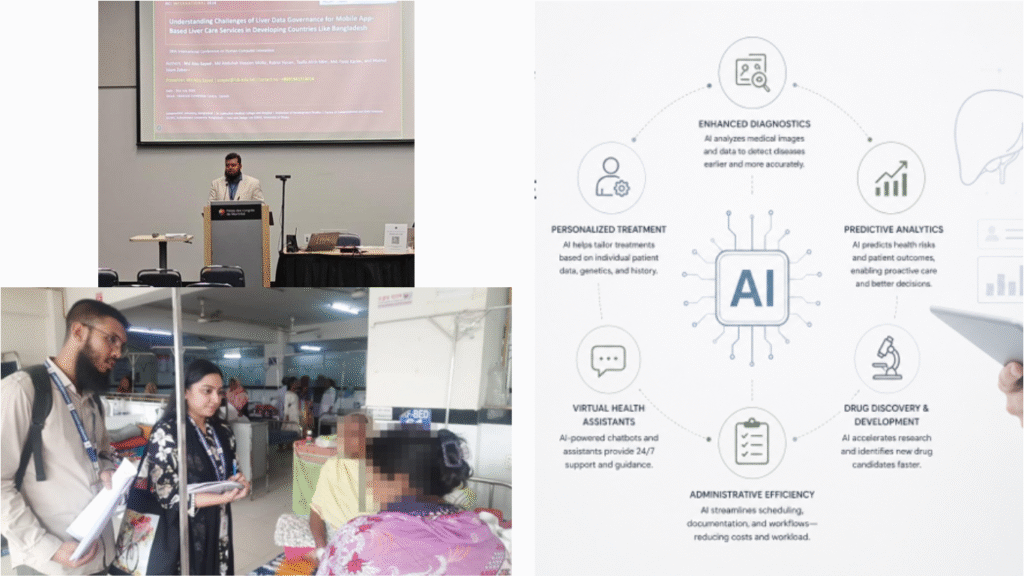
Adapted Method :
A hybrid approach had been adapted where the underlying challenges were seen from two perspectives. One is from the perspective of the people involved in the healthcare ecosystem and another is from the perspective of the technical and the operational needs.
Through a rigorous documentation analysis and qualitative study it is understood that the data generated from healthcare facilities are fragmented and can be used to create a patient’s electronic health profile and medical history that might help both the doctor and patients to improve the diagnosis efficiency and quality. Although doctors, patients, and administration are more than ready to adapt to the technology, the policy frameworks required to govern such technology is still an understudied area. The team strives further to understand and work regarding the policy and governance of the data and AI and create a proper framework that can serve such healthcare technology with required sustainability. This study has been published in the Proceedings of the 28th International Conference on Human-Computer Interaction (HCI International 2026), Montreal, QC, Canada. This research is sponsored by Independent University, Bangladesh as a whole and the team representing Center for Computational and Data Sciences works in collaboration with Sir Salimullah Medical College and Mitford Hospital, Institute of Development Studies, Brighton and Data and Design Lab, University of Dhaka.